As a former high school English teacher who taught The Scarlet Letter numerous times (I was skeptical the first time I brought the novel into the classroom, but kept using the text because students had such engaged responses), I am most interested in Berlant's reading of the end of the novel. She posits:
"The moral [Hawthorne] puts forth, that to be 'true' is to '[s]how freely to the world ... some trait whereby the worst may be inferred!' exhorts the citizen/reader to donate her/his body to public intelligibility. From the point of view of this maxim, the narrative aims to install a memory of the consequences that persons, citizens, and states suffer when the subject insists on her/his physical and psychic opacity or autonomy from the community" (157).
My former students were drawn to the same passages regarding truth, freedom and expression of self, but their reading was very different from Berlant's. (Are we surprised?! Not once did a high school student refer to Hester Prynne as a "prosthetic phallus" ...) For my students, "the office of the scarlet letter" was to remind us to be ourselves, who we really are, flaws and all. The end of the novel was for them an invitation to let their hair out of its bonnet to glisten in the sun, and to unpin from their chests the repressive labels placed on them by their parents or teachers or peers. They read Dimmesdale's death as a reminder of the consequences of waiting too long to be honest about one's true self, and the ambiguous community responses to his confession and death as proof that his fears about speaking his truth were unwarranted. For my students, the counter-memory of personal truth prevailed in the novel, as further confirmed by the altered meaning of the A--the repressive label was transfigured through honesty and good works.
But Berlant shows that while Hester's responsibility toward the end of the novel is "to reempower the minister, to return to him control over language, the law, and his own body, so ruthlessly taken away from him by their engagement in a 'link of mutual crime' and negative law"--a goal which privileges the self over the community symbolic--the narrator has a different objective (134). According to Berlant, "the narrator's mission, following Dimmesdale's self-exposure, is to rescue the law from its humiliation, to eradicate the amnesiac technology of the state, and to make Puritan culture 'safe' for the future identity of the postrevolutionary nation" (134). In other words, we are invited to make counter-memory the material of the state, in exchange for "a fantasy of boundless identity" (216).
Berlant suggests that we engage with the paradoxes, not the dichotomies, of self/nation and personal/political. Ben Highmore, in one of our early readings, proposed that we engage in the everyday as "an architectural practice" whereby we uncover "a house of material memory opposed to the constructed memory of nation" ("Dwelling on the Daily" 43). If I'm reading Berlant correctly, she seems to suggest that without the construction of nation we might not find a comfortable place to dwell at all.
Sunday, April 26, 2009

Monday, April 20, 2009
Changing music to fit European models
While reading the selections from Jon Cruz’s book, I was reminded of my experiences in choir. Cruz quotes Thomas Fenner “Our desire is, not to obtain any song in a more or less changed or mangled conditions, as you surely do when you take it out of its foreordained and appropriate setting in some part of the complicated negro religious ritual, and adapt it to be sung as a regular four-part song by a choir or congregation, either white or black” (170). I have been in different choirs from junior high to university, and we sang some of these four-part black spirituals. It was unsettling to me when we would sing them because I thought we looked and sounded ridiculous. Our voices didn’t possess the depth of sorrow that was needed at least from my limited knowledge. I thought about the chapter in Deloria’s book on music and how the people transcribing the Indian music couldn’t get the rhythms or sounds right. I find it interesting that these same ideas existed in transcribing black spirituals, this idea of pressing the music into a European model of music, time signatures, notes and accents.
A few years ago I watched a movie called “Songcatcher” about a woman who goes into the Appalachian Mountains to document some of the music of the people living there. I don’t remember everything about the movie, but what stayed with me was how difficult it was to capture the music and put it on paper, transcribing a sorrowful piece of music like “Pretty Saro” on to paper with lines and black dots for notes and set rhythm. It just doesn’t portray the song’s sadness, timbre or accents. It’s difficult to represent a song perfectly. I know it’s important for folklorists to find a way to document music from different cultures and that really the only way to do it is within the paradigms of our own knowledge, but I wonder if there is a different way because things are lost by forcing the music into European models.
-Colleen Murphy
Inda's Values
While reading Inda's Value of Immigrant Life I was struck very early on by an argument made on the first page, about the struggle of government against illegal immigrants--police on the border and denying prenatal care in California. Inda argued that because of this, it meant that the government meant that immigrant life is less of value than that of regular citizens. I did not initially buy that argument. It was not in Inda's idea, but rather the presentation of it. Believe me, when I read that prenatal care was being denied to illegal immigrants I was shocked. The care is not denied to the immigrants, but the the children themselves. On that issue, I do buy the argument that the value of life for these children is decreasing in the government's eyes. Humanitarian aid should not be given out as a reward. It should be standard. Being such a controversial subject, I would had hoped that Inda would have expressed that one point with more power than it holds.
It's always interesting to read articles and listen to opinions about immigration reform/problems/arguments/life. I believe the best way to tackle it is to read everything I get my hands on. Being from the East Coast the immigration I knew was the German and Irish immigrations from the 1800's and that history. The hatred, the eventual assimilation, and now the "melting pot" that is the US, that is the East Coast. I knew that story. I did not know the borderland story. The most recent immigration wave to my coast was the Cuban and Puetro Rican immigration influence, but at best I grew up with 1st and 2nd generation Puerto Rican-Americans. So it is interesting to read the different points and counterpoints of the issue of illegal immigration. However, I did remember this dispute: http://abcnews.go.com/GMA/story?id=2057207&page=1, http://www.foxnews.com/story/0,2933,198757,00.html about Geno's Steaks (the most famous cheesesteak place, besides Pat's, in all of Philly, owned by the descendant of Italian immigrants). The owner had a personal history of his grandparents being immigrants from Italy and "struggling to learn English," which he used as a point that if his family had to do it, wanted to do it, and struggled to do it, to become "American" (I remember that part from an onair interview) so should other people seeking ways into America. Nowadays, I feel like that one view is becoming a regular point in conservative/anti-illegal immigration talk. I found this to be a very interesting dynamic--how two waves of immigration were similar and yet so different. This was the first real insight into this particular issue (from my end) that was looming across the nation. I would actually like to do more reading into why this immigration wave is different to the nation, when other waves in the past have been struggled against, this one, the issue of the border, is being tackled by gates, guns, and discriminatory aid--and the lack thereof.
Jennie Ziegler
sets and stages, slaves and prostitutes
Let me start off by quoting from Jay Roach's article on slave spectacles:


"The apparent callousness of such accounts may be in part explained (though not in any way excused), by the very normality of the slave trade in the performance of daily life in New Orleans. The restored behavior of the marketplace created by its synergy a behavioral vortex in which
human relationships could be drained of sympathetic imagination and shaped to the purposes of consumption and exchange. Under such conditions, the most intolerable of injustices may be made to seem natural and commonplace, and the most demented of spectacles 'normal.'" Pg. 53
Roach is talking about the stage upon which slaves were sold and the performance of human indignity enacted, but the whole time I was reading his article, I kept flashing on the new TV show, Dollhouse. For those of you who aren't familiar with it -- which you should be, it's fantastic -- Dollhouse is about an underground
organization that traffics in a human slavery via technology. A "Doll" or "Active" is conscripted for a term of five years, most under duress, during which they are taken out of the Dollhouse, programmed to be anything their buyer chooses, and then put back in the Dollhouse when they're done being "played with." It's a show that plays with the themes of consent, control and freedom, and the spaces in which these acts are performed are eerily like what Roach was describing in his article.
Roach goes on to describe in detail the place of performance for the slave auctions, the pleasant aura of which made it possible to pretend that the slaves were anything but human beings. The Dollhouse, like the institution of slavery, takes human bodies, and going even further, human minds, and turns them into goods for consumption and profit. There are many layers of performance in the show. Obviously, there are the Dolls themselves, who are programmed with new identities at alarming rates. Then, there are those who run the Dollhouse, who tell themselves that what they are doing is normal and, in a way, philanthropic. The space they have constructed for themselves reinforces this notion.
The Dollhouse itself is a place of peace and zen, in which Actives when not on duty go to relax, get a massage, paint some art, or partake in banana pancakes. It is an elaborately constructed ruse, both to fool the Dolls into complacency, and on a less conscious level, to fool themselves into believing, to quote Roach, what they do is "natural and commonplace." Roach's fixation on the space of performance is a really interesting one to me. When he switches to the sexualization of slave bodies, saying, "I believe that slavery was explicitly and officially sexualized -- and thereby at least symbolically recuperated -- in the development of legally sanctioned prostitution during the post Reconstruction 1880s," my thoughts still stuck on Dollhouse. The show itself is like a slave spectacle. Each week viewers watch as the helpless dolls are programmed for deeds good and bad, and we as free beings are lead along for the ride, complicit in the crimes being committed against these fictional characters, and those real people that they represent.
--Ashley
All About Context: Artifacts Are Not Produced in a Vacuum
“All music is ‘folk music.’ I ain’t never heard a horse sing a song.”
--Louis Armstrong
(this quote is not directly related to the thoughts I explore here, but I like it and wanted to include it)
I am not at all a science person, but when I was reading Jon Cruz’s exploration of the black spiritual, I could not help but think in scientific terms. I thought of the right conditions, variables, hypotheses. What I liked most about his work was the way it challenged the notion that either artifacts or testimonies are sufficient in exploring the history of a cultural experience. They are important to study, but so too is the historical context that surrounds them. I think we often look at artifacts out of context without realizing 1) that our perceptions of the products are totally defined by our own knowledge and experience (for example: the way we perceive slave spirituals is influenced by the country and region we grew up in, what textbooks we have studied and what they say about the history of slavery, whether our family was involved in the slave trade—on either side, what our conceptions are about the lives, emotions, thoughts of slaves, what our conceptions are about the morality of slaveowners, etc. etc. etc.) and 2) that there is a complicated historical situation that these artifacts emerged from before they were “preserved” (for example—as Cruz explores—the slaves being unaccepted by white culture and thus needed to retain their cultural identity as West Africans, slaves being taught Christian tenants and hymns and the evolution in white owners as thinking of slaves as having “souls” which allowed them to do so, songs as anthems adopted for abolition, songs as ways to maintain confidence in the self despite being constantly put down).
Cruz discusses how looking at artifacts themselves led people to disregard the people who made them, projecting their own ideology of what those people thought or felt onto them through the reader’s interpretation of the song. He says, “one would never really need to know much about historical subjects who were displaced and rendered invisible by the triumph of their artifacts.”
Cruz aims to “move toward understanding the spiritual as a culminating point upon a sociohistorical map.” He “treat[s] black song making as a cultural site, an intersection, where we see social interests and social struggles coincide and entwine as we go through the process of discovery and mapping black culture.” I thought this was really interesting to look at the production of the songs as a place on a timeline, where slaves producing the song were reflecting what they had experienced, where they were at the moment in light of their context, and in some ways, alluding to what was to come. I thought it was fascinating the way he looked at the black university choirs’ performance of the spirituals and the excitement national and international audiences as fueling the research, transcription, preservation and performance of these songs.
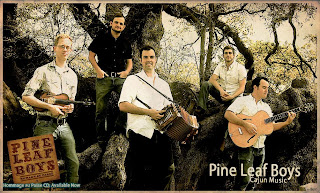
I began to think about this too in relationship to music in my homestate of Louisiana. There has been a recent rise, over the past five years or so, in young Louisiana musicians creating Cajun or Zydecho bands—and oftentimes a mix of the two. They record, they play in Louisiana, they tour. The bands, like the Pine Leaf Boys, often cite their desire to play this music because they learned this style of music growing up and want to continue in the tradition of their parents and older Cajun musicians. They often put their own style and twist on traditional tunes, and add their own songs, written in traditional styles, to the mix. But the other fact is that more and more cities and communities throughout the United States have begun to host “folk music festivals,” “Cajun music festivals,” “bluegrass festivals” over the past decade or so. With the growth of these festivals—oftentimes free or with a low ticket price—event organizers have created a demand for these bands. Before, there were a few festivals throughout the country, mostly in large urban areas. But now smaller cities like Tucson and even small towns in states like California are joining in. With the interest in the community, these events are popular, and with this popularity comes a desire to bring in diverse acts from all over. We have an old-style country band, a old-timey band, a couple of blues musicians, now we need…. A Cajun Band.
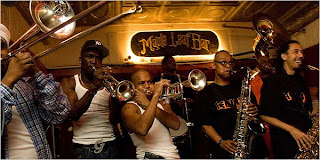
A similar thing has happened with brass bands in New Orleans. Brass bands evolved out of the Mardi Gras tradition in New Orleans. Bands, most often from mostly African American schools, would march in the parades, and the most talented musicians, upon graduation, repurposed their skills into large brass ensembles. One such musician was Kermit Ruffins, who graduated from St. Augustine High School to form Rebirth Brass Band. Since Ruffins formed Rebirth over twenty years ago, the band has gone through many formations, with members cycling in and out. And over time, brass bands became another signifier for New Orleans—with bands playing gigs on MTV and touring the country. As brass bands became a signifier of New Orleans, traveling brass bands gave people from other places a taste of New Orleans without having to actually get on a plane. Now there are dozens of brass bands in the city—Hot 8 Brass Band, Dirty Dozen Brass Band, Soul Rebels Brass Band, Treme Brass Band, New Orleans Brass Band. A further increase of popularity and notoriety of these bands came after Hurricane Katrina, when many bands were displaced and toured the country playing shows more out of necessity than desire. Their home was a wreck. Bands that typically were home for most of the year were on tour more, exposing more people throughout the U.S. to their music and to the “culture” of New Orleans.
In all these cases, studying the context for music making does not make the artifacts themselves less significant. In fact, quite the opposite. By taking the time to examine the artifacts in the historical location where they were constructed, we can see them in a richer, more fleshed-out light. For it is not just about the making of the product, but how that making was influenced by and in turn influenced the culture around it.
~ Lisa
Images:
Pine Leaf Boys-- from Pine Leaf Boys website, publicity shot
Rebirth Brass Band- By PABLEAUX JOHNSON for New York Times
Published: November 26, 2006
--Louis Armstrong
(this quote is not directly related to the thoughts I explore here, but I like it and wanted to include it)
I am not at all a science person, but when I was reading Jon Cruz’s exploration of the black spiritual, I could not help but think in scientific terms. I thought of the right conditions, variables, hypotheses. What I liked most about his work was the way it challenged the notion that either artifacts or testimonies are sufficient in exploring the history of a cultural experience. They are important to study, but so too is the historical context that surrounds them. I think we often look at artifacts out of context without realizing 1) that our perceptions of the products are totally defined by our own knowledge and experience (for example: the way we perceive slave spirituals is influenced by the country and region we grew up in, what textbooks we have studied and what they say about the history of slavery, whether our family was involved in the slave trade—on either side, what our conceptions are about the lives, emotions, thoughts of slaves, what our conceptions are about the morality of slaveowners, etc. etc. etc.) and 2) that there is a complicated historical situation that these artifacts emerged from before they were “preserved” (for example—as Cruz explores—the slaves being unaccepted by white culture and thus needed to retain their cultural identity as West Africans, slaves being taught Christian tenants and hymns and the evolution in white owners as thinking of slaves as having “souls” which allowed them to do so, songs as anthems adopted for abolition, songs as ways to maintain confidence in the self despite being constantly put down).
Cruz discusses how looking at artifacts themselves led people to disregard the people who made them, projecting their own ideology of what those people thought or felt onto them through the reader’s interpretation of the song. He says, “one would never really need to know much about historical subjects who were displaced and rendered invisible by the triumph of their artifacts.”
Cruz aims to “move toward understanding the spiritual as a culminating point upon a sociohistorical map.” He “treat[s] black song making as a cultural site, an intersection, where we see social interests and social struggles coincide and entwine as we go through the process of discovery and mapping black culture.” I thought this was really interesting to look at the production of the songs as a place on a timeline, where slaves producing the song were reflecting what they had experienced, where they were at the moment in light of their context, and in some ways, alluding to what was to come. I thought it was fascinating the way he looked at the black university choirs’ performance of the spirituals and the excitement national and international audiences as fueling the research, transcription, preservation and performance of these songs.

I began to think about this too in relationship to music in my homestate of Louisiana. There has been a recent rise, over the past five years or so, in young Louisiana musicians creating Cajun or Zydecho bands—and oftentimes a mix of the two. They record, they play in Louisiana, they tour. The bands, like the Pine Leaf Boys, often cite their desire to play this music because they learned this style of music growing up and want to continue in the tradition of their parents and older Cajun musicians. They often put their own style and twist on traditional tunes, and add their own songs, written in traditional styles, to the mix. But the other fact is that more and more cities and communities throughout the United States have begun to host “folk music festivals,” “Cajun music festivals,” “bluegrass festivals” over the past decade or so. With the growth of these festivals—oftentimes free or with a low ticket price—event organizers have created a demand for these bands. Before, there were a few festivals throughout the country, mostly in large urban areas. But now smaller cities like Tucson and even small towns in states like California are joining in. With the interest in the community, these events are popular, and with this popularity comes a desire to bring in diverse acts from all over. We have an old-style country band, a old-timey band, a couple of blues musicians, now we need…. A Cajun Band.

A similar thing has happened with brass bands in New Orleans. Brass bands evolved out of the Mardi Gras tradition in New Orleans. Bands, most often from mostly African American schools, would march in the parades, and the most talented musicians, upon graduation, repurposed their skills into large brass ensembles. One such musician was Kermit Ruffins, who graduated from St. Augustine High School to form Rebirth Brass Band. Since Ruffins formed Rebirth over twenty years ago, the band has gone through many formations, with members cycling in and out. And over time, brass bands became another signifier for New Orleans—with bands playing gigs on MTV and touring the country. As brass bands became a signifier of New Orleans, traveling brass bands gave people from other places a taste of New Orleans without having to actually get on a plane. Now there are dozens of brass bands in the city—Hot 8 Brass Band, Dirty Dozen Brass Band, Soul Rebels Brass Band, Treme Brass Band, New Orleans Brass Band. A further increase of popularity and notoriety of these bands came after Hurricane Katrina, when many bands were displaced and toured the country playing shows more out of necessity than desire. Their home was a wreck. Bands that typically were home for most of the year were on tour more, exposing more people throughout the U.S. to their music and to the “culture” of New Orleans.
In all these cases, studying the context for music making does not make the artifacts themselves less significant. In fact, quite the opposite. By taking the time to examine the artifacts in the historical location where they were constructed, we can see them in a richer, more fleshed-out light. For it is not just about the making of the product, but how that making was influenced by and in turn influenced the culture around it.
~ Lisa
Images:
Pine Leaf Boys-- from Pine Leaf Boys website, publicity shot
Rebirth Brass Band- By PABLEAUX JOHNSON for New York Times
Published: November 26, 2006
Looking at Performance and Collaboration
I have never had the opportunity to read or learn about this time in history, so I found all the readings quite compelling. Having a background in theatre, I thought that Roach’s definition and application of the term “performance” to be an interesting one. In regards to the marketplace, Roach says, “I would interpret the performative space of the exchange as a behavioral vortex of consumption and expenditure, material and symbolic” (54). It seems that the marketplace was like a theatre where people came dressed in their finest to see and be seen and to be entertained, and that the purchasing of goods was a secondary concern. Because the people at this time were accustomed to the daily performance aspects of the slave auctions, such as their dancing and being on display naked, they were not focused on the negative connotations that such acts implied. As Roach points out, “The apparent callousness of such accounts may be in part explained (though not in any way excuse to) by the very normality of the slave trade in the performance of daily life in New Orleans” (53). Perhaps these “normal” yet terrible spectacles could be seen as similar to public executions in Renaissance England or to other forms of public humiliation where human beings were on display. Levine goes on to analyze actual plays that contain similar themes to what is occurring daily. He writes, “By this I do not mean simply the depiction of a general historical and cultural “background” but rather the discovery of intersecting networks of practices, attitudes, actions, and meanings, those that reside in specific cultural conditions and those that become visible by means of performance” (58). As in earlier times, playwrights get many of their ideas for plays from actual events in everyday life. When playgoers see a play, they identify with, disagree with, or are informed about the subject matter. Obviously these performances of everyday life can have an impact on one’s views or interpretations of a cultural practice.
In addition to Roach’s topic of performance, I was intrigued by Levine’s chapter on slave songs. He writes, “Slaves often take over entire white hymns and folksongs, as White and Jackson maintained, but altered those significantly in terms of words, musical structure, and especially performance before making them their own. The result was a hybrid with a strong African base” (39). I thought about how most everything is a hybrid of some sort and that everyone builds off of others’ ideas. Even in today’s music world rappers and hip-hop artists borrow from each other and incorporate others’ work as a sign of respect and appreciation. However, a significant difference between re-creating song lyrics, either by the slaves or today’s musicians, and one’s written work based off of another’s thoughts is possession. I find this interesting that writers are so concerned with plagiarism and citing another’s work, but in certain types of music this practice does not seem to be as common. Levine points out, “Slave songs, then, were never static; at no time did Negroes create a “final” version of any spiritual. Always the community felt free to alter and re-create them” (43). Perhaps it is this sense of community that is more important than a sense of ownership. Because the songs were mainly recorded in an oral tradition and there was not a written record, this may account for the lack of concern of ownership, but more than that is this was a way that the slaves could bond together and maintain their sense of identity under horrible circumstances, which is what Levine argues when he states: “Here again slave music confronts us with evidence which indicates that however seriously the slave system may have diminished the strong sense of community that had bound Africans together, it never totally destroyed it were left to the individual atomized and emotionally and psychically defenseless before his white masters” (44). Unlike the whites, who focused on spiritual songs in a specific setting, like church, the slaves’ songs were created as their everyday lives unfolded, during good and bad times, and this was one of the ways they maintained a part of their culture. Kristin
In addition to Roach’s topic of performance, I was intrigued by Levine’s chapter on slave songs. He writes, “Slaves often take over entire white hymns and folksongs, as White and Jackson maintained, but altered those significantly in terms of words, musical structure, and especially performance before making them their own. The result was a hybrid with a strong African base” (39). I thought about how most everything is a hybrid of some sort and that everyone builds off of others’ ideas. Even in today’s music world rappers and hip-hop artists borrow from each other and incorporate others’ work as a sign of respect and appreciation. However, a significant difference between re-creating song lyrics, either by the slaves or today’s musicians, and one’s written work based off of another’s thoughts is possession. I find this interesting that writers are so concerned with plagiarism and citing another’s work, but in certain types of music this practice does not seem to be as common. Levine points out, “Slave songs, then, were never static; at no time did Negroes create a “final” version of any spiritual. Always the community felt free to alter and re-create them” (43). Perhaps it is this sense of community that is more important than a sense of ownership. Because the songs were mainly recorded in an oral tradition and there was not a written record, this may account for the lack of concern of ownership, but more than that is this was a way that the slaves could bond together and maintain their sense of identity under horrible circumstances, which is what Levine argues when he states: “Here again slave music confronts us with evidence which indicates that however seriously the slave system may have diminished the strong sense of community that had bound Africans together, it never totally destroyed it were left to the individual atomized and emotionally and psychically defenseless before his white masters” (44). Unlike the whites, who focused on spiritual songs in a specific setting, like church, the slaves’ songs were created as their everyday lives unfolded, during good and bad times, and this was one of the ways they maintained a part of their culture. Kristin
Sunday, April 19, 2009
I really enjoyed Della Pollock's "Exceptional Spaces: Essay in Performance and History" on several levels. First, I think the essay modus operandi--its establishment and setting of performance in light of slave auctions--was fascinating. The definition for performance that Pollack borrows from Richard Schechner was particularly interesting to me: "restored behavior" or "twice-behaved behavior." This sense of "re-doing" what has already been done was so brilliantly (albeit sickeningly) tied to Pollack's comparison of slave auctions to brothels and whorehouses which later took over New Orleans. I was most interested in Pollack's description of the triangular enterprise: money, flesh and property, with flesh dominantly displayed in the center. As Pollack says, "the centrality of naked flesh signifies the abundant availability of all commodities: everything can be put up for sale, and everything can be examined and handled even by those who are 'just looking'" (57). A bit later in the essay, Pollack takes this notion of transfer a bit further. Not only could anything by resold and transferred, but in that transfer, anything could be transformed: the protagonist Zoe is resurrected as a white woman, fully transformed and transfigured in her environment. Like a piece of scrap metal put under the flame, the body too can be reshaped and reformed in this spectacle of resale and rebirth.
This objectification of the body--especially female--can be quite clearly linked to the intentions of the brothels and whorehouses; this re-representation of behavior manifested in different environment made me curious regarding the recycling of slavery notions in our present day.
Simultaneously with this essay I was reading David Foster Wallace's "Big Red Sun" in which he explores the inside world of the 1998 Adult Video News Awards (AVNAs), the equivalent of the Oscars in Adult Porn. To rehash the entire essay would just cause me to become emotional and rant: suffice to say that Wallace, if he were in conversation with Pollack, would probably see some parallelisms--especially in light of this triangular exchange--between the slave auctions and later the brothels of New Orleans and the AVNAs in Las Vegas (yes, that's right; the show is hosted every year in Vegas--go figure).
--Julie Lauterbach-Colby
Performance
I thought Roach's take on a performance based view of slave auctions was extremely interesting and well-written. The more in-depth the analysis became, the more questions I had about the intricacies of this view. The one that made me the most curious was the possible connection to the theory of dramaturgy and the designation of backstage spaces. Would it be possible to identify a “backstage” in his view?
If the auction stage became a nexus of commerce and performance where the culture of flesh becoming object was played out, the backstage area would have to be a location where some kind of facade or mask was dropped. I originally believed that space historically would be emancipation. Both performance and commerce functioned as attempts to distract from the humanity of the people being auctioned. In performance, a player consciously makes him or herself an object of scrutiny. This allows the audience to view a slave as both consciously choosing their actions and willingly becoming objects at the same time. The connection between commerce and dehumanization should be obvious. The moment when those masks or costumes were dropped would be the moment that humanity was restored to slaves and emancipation from the stage was achieved.
However, I think now that “backstage” was any moment that those people were free from the scrutiny of their oppressors. Any moment where they felt they were asserting their humanity, whether through song or action. Emancipation would be the moment where backstage became the only stage.
-Caitlin
Eroticizing Slavery
Like most of the essays and articles for this class, this week’s selection about slavery was new information to me, but nonetheless interesting and providing new insights. In particular, it shed light on how much we take for granted in terms of what information is used to frame our culture and what is omitted from history. The sense of bias and subjectivity of the people engagaged in the slave trade or witnessing it as spectacle is hard to fathom--far too often we accept what is told to us, written down, or depicted in photography and painting without contextualizing the information or peeling away the layers of specificities, agendas, and motivations that allow such information to become irrefutable fact in our minds.
In particular, I was intrigued by the article by Joseph R. Roach, “Slave Spectacles and Tragic Octoroons.” First, I had not thought about the myriad actions that we call everyday life as performative, but indeed they are—we perform at the workplace, at our gyms and on our days off; for our friends, our colleagues and co-workers, and in a self-reflexive way, for ourselves. In short, everything that implies action of some sort is performative and furthermore, as Roach suggests, “The performative. . . is a cultural act, a critical perspective, a political intervention.” (p. 49)
With that framework in mind, it was interesting to see how the author addressed the performative traditions of the trafficking in human flesh in antebellum America to link it to present-day practices of eroticized spectacle. Of course, one of the most obvious of the “collective representations” to which the author refers is art. The many paintings, sculptures, and films, etc. that I have seen which address the theme of slavery now come back to me to be considered in a new light. That those during the antebellum period rationalized their practice of “exhibiting” slaves to be sold because they found precedents in ancient Greek and Roman times seems incredible. Given that we have long held up those cultures as paradigms of civility and order, the delusion that slavery was acceptable behavior has to link to something perceived to be rational in order to be desensitized enough to take part in it.
More appalling, however, is the circus-like atmosphere that was created. It was one thing to insist that for the progress of America we must stoop to unprecedented lows to find the workforce needed to keep up the demand of product, but to be entertained by the spectacle complete with musical accompaniment and costumes reveals just how little the people of the time were normalized into thinking this was acceptable behavior. Of course, as the author explains, while such behavior appears beyond callous, “The restored behavior of the marketplace created by its synergy a behavioral vortex in which human relationships could be drained of sympathetic imagination and shaped to the purposes of consumption and exchange.”(p 53)
Furthermore, the elegant, theater-like rotunda connected to the St. Louis Hotel further legitimized the practice, for if an opulent building is erected for such purposes, does it not reinforce the notion that such an enterprise is an extension of sophisticated society? It is no wonder that a leap can be made from the slaves who were stripped down for the examination of their bodies to the display of prostitutes in the brothels—so often we are expected to believe that sex workers prefer their profession over other types of employment, just as we are led to believe that slaves accepted their plight. And while it might be a plausible notion, as the author suggests, that the practice of forcing slaves to dance in semi-nudity for prospective buyers anticipated the development of American musical comedy, it only reinforces the notion that it was spawned by callous indifference to what was really taking place, especially since the minstrels were performed by whites in blackface.
Of course, the idea that paintings were sold in one part of the rotunda, slaves in the middle, and land in another, while beyond despicable, clearly illustrates the institutionalizing of desire and possession. Of the many paintings and etchings that were mentioned in the essay, I wonder how many of the artists were complacent in their selection of subject matter or if they stepped outside of their exotic reverie to realize what stereotypes they were establishing and myths they were promulgating, all for money. In many ways, such artists, while lacking the cultural hindsight to access the practice in more humanistic terms, are much like prostitutes—they play on the prospective buyers need to possess and to fetishize everything, giving them what they want all in the name of formal artistic concerns and exoticism. To call the slave spectacle as American as baseball, however, seems to me to be a big stretch by the author. While the average man might have been allowed to “inspect the merchandise,” it implies that large audiences chose to partake in witnessing the slave auction over other forms of entertainment. I surely hope this is not true, but while I thought at first the analogy to the New Orleans Superdome to the slave market rotunda a bit far fetched, on second thought, it is not without merit that we are engaging in a similar practice of spectacle, albeit with the players in command of their present and future, agreeing to the fetishization of their bodies to the highest bidder. Giving people what they desire through surrogate performative practices and representations therefore places athletes and artists in the same category perhaps. They are each performing for an elite consumer which then trickles down to the middleclass citizen who, in parody of what they think is the embodiment of desire, takes the game, or the reproduction of the painting in the case of the artist, as an acceptable surrogate to the real thing. Not to diminish the deplorable practice of slavery where there is no choice in the matter of the servitude or the spectacle of the auction, however, it is interesting to note the strategic dance between desire, possession, and need that still plays out in contemporary society.
-Julie Sasse
Artifacts vs. Testimonies
In Jon Cruz's book I was most startled and struck by the section titled "Triumph of the Taxonomic." In this section Cruz quotes a song that includes the lines, "Fall out here and shuck dis corn / Oh. ...oh, ho / Bigges pil ever see sence I was born / Oh. ...oh, ho" (182). The rest of the song is a commentary not just on the physical labor demanded of the speaker, but a kind of lament and description of a world out of joint. For example, the line "What in the worl' is de marter here" is repeated at the beginning of the song, and the later verses narrate the social dynamics of slavery: subjugation, ownership, class divides and resentments, etc. The surprising thing is that the song was classified as a "corn song," corn songs being a sub-category of "work songs" in the new taxonomy. As Cruz writes, "What underwrites this historically embedded text's social reference--the social relations of slavery--is eclipsed by a budding ethnomusicology. In the new scientistic view, the song took on significance through ... the framework of the taxonomy that gave it a new place within folklore" (182). In other words, the same impulse that sought to make an artifact (as opposed to testimony) of a lived expression and a lived art--hence lodging the song as an object within the past--also divorced the song from the very past it was taxonomized within. "Technical neutrality" obscures the social reality--both the social reality of slavery, and the social reality of folkloric preservation and classification that alters and reinscribes and resignifies expressions as merely forms (183).
Of course, Deloria's chapter on music comes to mind, especially the section on musicologists' efforts to understand Omaha harmony. John Comfort Fillmore found that in the Omaha music he studied, "the melodies did imply harmony--indeed, a universally shared harmony--and could, therefore, be understood through standard music systematics" (Deloria 201). But in classifying Omaha music, Fillmore furthered developmentalist ways of understanding the world: Fillmore found in the music a "latent harmonic sense" (Deloria 201). In other words, Fillmore and others were able to simultaneously say that Indian music was just like European music, and less developed than European music. So, it was safe to appropriate Indian melodies as nationalist music because doing so furthered the desire to both highlight what was authentically American AND confirm the progress of European colonization.
In discussing folkloric approaches to understanding and documenting music from marginalized social and racial groups, Cruz and Deloria remind us of the dangers and responsibilities inherent when, in wanting to document or understand something, we deliberately or inadvertently objectify lived expressions of social experience. Reading Cruz and Deloria's critiques/warnings makes me appreciate Kathleen Stewart's approach even more. She said there's no perfect text for the social, but didn't abandon the effort of letting the surfeit of the social speak through her text. What other models do we have in this social moment?
- Esme
Conscious Blurring of the Sacred and Mundane
I’d like to offer some fragmentary comments on Lawrence Levine’s reading of slave songs and the potential to read misrecognition or misunderstanding as a practical break or fissure in totalizing power relationships, particularly in relationship to the totalizing narrative of oppositional subjectivity/identity established in Hegel’s model of the master-slave dialectic.
Levine quotes Clifton Furness writing about a prayer meeting, in a way that appears at first to reify slave consciousness as ripe for subordination: “I was gripped with the feeling of a mass-intelligence,” Furness writes, “a self-conscious entity, gradually informing the crowd and taking possession of every mind there, including my own” (42). He (Levine) interprets this passage and others as
mak[ing] it clear that the spirituals both during and after slavery were the product of an improvisational communal consciousness. They were not, as some observers thought, totally new creations, but were forged out of many preexisting bits of old songs mixed together with snatches of new tunes and lyrics and fit into a fairly traditional but never wholly static metrical pattern. The were, to answer Higginson’s question, simultaneously the result of individual and mass creativity. (42).
The interpretation is needed, I think, to dispel another potential reading of Furness’s description. Before getting to the passage above that comes from Levine’s pen, I took Furness’s reading of the songs as an implication of a divide between the mass-intelligence and the individuals who formed that mass. It was as if they were caught up in it, but not really responsible for the creative act; as though they were a vehicle for some larger consciousness, but not conscious themselves. We could see this in the “self-conscious entity” that “informs” the crowd, meaning that the crowd becomes a formless void, waiting to be imbued with meaning by some transcendent power or idea(l). The difference for my initial reading of Furness and Levine’s, comes from an expectation on my part (to go back to Deloria) that the researcher will see the slaves as less intelligent or self-conscious when reading through a modernizing European model.
This expectation surfaced earlier in my reading as well, when Levine describes the, “spontaneity, this sense of almost instantaneous community which so impressed Higginson, [that] constitutes a central element in every account of slave singing” (40). Initially, I had been wondering why he decided to look at slave songs coming from only the religious or spiritual setting. In other words, if the spiritual setting established a kind of communal consciousness/entity, and Levine interpreted this as a synecdoche for slave life, I wanted to know if it was a sampling error, if the spontaneous communal creativity seen in the churches, was something mirrored by all instances of singing, or if his reading was hiding an ability for individual composition and creation. However, Levine goes onto address this question, which rests upon an assumed distinction between everyday life and heightened circumstances, such as church (or art, or, or, or). Levine seems to want us to see the songs arising from everyday life (of which spirituality is an integral part), instead of as an unconscious expression of lived reality (and therefore, if we follow the typical construction of slave insight as unconscious: less intelligent, less articulate, (almost) accidental). Levine sees the lines between the everyday and the transcendent as consciously blurred, or blurred in (slave) consciousness. This blurring highlights the important difference between slave and master social or cultural practices and understandings, in which the slaveholder relies upon a separation of the transcendent from the everyday in order to justify his or her terrorizing of others while still maintaining a sense of spiritual purity.
Levine spots this difference in the opposing conceptions of what it means to be a chosen people. Noting that it might be surprising to see slaves conceiving of themselves as a chosen people in their songs (which we do), he writes that
White Americans could be expected to sing of triumph and salvation, given their long-standing heritage of the idea of a chosen people which was reinforced in this era by the belief in inevitable progress and manifest destiny, the spread-eagle oratory, the bombastic folklore, and paradoxically, the deep insecurities concomitant with the tasks of taming a continent and developing an identity. (45)
The heightened sense of what it meant to be chosen enabled slaveholders (or the majority of white Americans, even in the North) to imaginatively transcend the mundane everyday through the imagined ideal of exceptionalism or ordained destiny. The slaves, on the other hand, lived through their everyday. The way we read the relationships between the words in the second part of this statement seems important. If the slave lives through, slogs through, only survives his or her everyday, it becomes a mundane terror, something from which to escape. However if we see the slave living through or within that mundane and terrifying reality as it was perceived by others (the slaveholders), then the relationship between the secular and sacred, the mundane and the transcendent becomes more complex. To go back to the problem of when the songs were sung, Levine affirms that “they were not sung solely or even primarily in churches or praise houses, but were used as rowing songs, field songs, work songs, and social songs” (48). “For the slaves, then,” he writes, “songs of God and the mythic heroes of their religion were not confined to any specific time or place, but were appropriate to almost every situation” (48). Therefore, the sacred intertwines with the profane, or everyday, and becomes a way of reading it. While for the slaveholders it was an escape from mundaneness, sacredness for the slaves was a means of finding meaning in the moments and meanings that slipped through, or perhaps more accurately, that coexisted with the awfulness of their bondage.
This treatment of the everyday life of the slave is not an attempt to romanticize his or her spirituality, which becomes again a dangerous way of primitivizing difference. Rather, it de-trivializes slave songs. The temptation to read the songs as primarily something performed in the church, and therefore separated from everyday life not only establishes a foundation to see slave songs as derivatives of European-based hymns (which Levine argues against early in the essay), but also pushes their message of salvation into an otherwordly realm of sacred belief and hope. As Levine puts it, understanding this blurring of the sacred and everyday means that we see “the manner in which the sacred world of the slaves was able to fuse the precedents of the past, the conditions of the present, and the promise of the future into one connected reality” (54). This connection of past, present and future into one concurrent reality seems an important idea, one that gains currency if we consider Levine’s suggestive title. “Slave Songs and Slave Consciousness” calls to mind not just the communal entity forged through the songs that the article analyzes, but also the Hegelian model of subjectivity (if I understand it properly) in which there is a master consciousness, recognized in the dominance of the slave by the master. Slave consciousness then becomes consciousness of the master, or rather, consciousness of the presence of the master, and the experience of terror in that presence. Levine characterizes the typical reading of slave songs as derivative as something that follows this logic. However, the “vitally creative elements of slave culture” remained, meaning that the system to enslaved the slave did not “so totally [penetrate] his personality structure as to infantilize him and reduce him to a kind of tabula rasa upon which the white man could write what he chose” (57). This vision of the slave as a blank slate means that his consciousness of self has either been erased, or, as in Hegel’s model, exists only as a derivative of the master’s consciousness. Hegel tells us that the slave gains self-consciousness through the realization that his work (as material manifestations of his presence in the world) is appropriated by the master. In other words, he gains self-recognition only through consciousness of alienation from himself. Levine’s reading of the slave songs challenges this concept, because in order for it to function properly, the slave must have no remaining vestiges of his originating culture or tradition through assimilation. Thus, the narrative that slave songs derived from Christian hymns, but not the other way around. Levine writes in opposition to this model that the slave could either be seen as “divested of old cultural patterns but not allowed to adopt those of their new homeland,” or “cling[ing] to as many as possible of the old ways of thinking and acting” (57). He argues that the slave songs represent the second of these options, which is positive in a sense, but I think we might see in his argument another. Early on, as alluded to above, he writes that the musical influence that created the slave narratives ran across the cultural divide in both directions, making it less a division than a point of mutual re-creation (37). While the songs did not change the political situation of the slaves, they did challenge the oppressive reality in other ways (58). I think we might see this challenge in the different model of slave consciousness that the songs represent, one that, like DeCerteu’s idea of la perruque, enables on a means of reading one’s surroundings differently from the structures or strategies that shape that reality. The songs as tactical interventions in the everyday life of slaves means, as Levine argues, that they open another field of communal meaning and relationship that the slaveholders either assumed was confined to Sundays or that they misrecognized entirely.
-- Andy DuMont
Dislodged Songs
The reading that really struck me this week was Jon Cruz's "Culture on the Margins." It was a quote pulled from Thomas P Fenner that I found the most thought provoking. Cruz notes Fenner's argument that songs should be viewed as "activities and practices" and that, "Dislodging songs from their context and transporting them through musical transcription invariably resulted in the loss of meaning (169).
We've talked a lot in the class about the way that the everyday is constructed by our culture and I find myself often thinking about the way that the very act of analyzing and recording an event or artifact can change it (very quantum). But I have never thought about it in the way that Cruz describes it. The song is not just studied, it is "dislodged." The word implies two things for me. One, the act of study implies a kind of violence across the object. Force is applied to seperate the artifact from it's context. The work not only can damage the object, but what of the context to which it belonged? Do we leave a sort of theoretical hole or scar on that context? The image that comes to my mind is my father working at pulling up a tree stump from our backyard. The stump was eventually pulled, but in the process the earth around it had be churned up and a whole mass of tiny roots had been riped off and left in the group.
Two, too believe we can dislodge an artifact from its context seems to imply that we can examine it in some sort of cultural vacuum. I think most in the class would agree that this is not true. But it does point to the reason that we strive to "dislodge" the artifact in the first place. It seems that this sort of study is employing methods more suited to the physical sciences than the social sciences. When we dislodge an artifact, we are trying to be objective and to limit variables, to control our experiment. There are any number of historical, political, and social reasons we would do that (some of which we've already talked about). But in the end, I think the most important thing to realize is that, in the social sciences, dislodgement often means that the artifact we are studying is very often not the same as the artifact before our attempts to pry it free.
- Josh Zimmerman
Torture as Performance

Jay E. Caldwell
19 April 2009 (Sunday)
Joseph Roach's remarkable essay, "Slave Spectacles and Tragic Octoroons," got me thinking about other sorts of "performances" and spectacles not necessarily designed to be that, and certainly more private. Mark Danner's recent piece in the New York Review of Books (LVI.6 [9 April 2009]: 69-77): "U.S. Torture: Voices from the Black Sites" is a sort of theater review. It is actually an enhanced review of the ICRC [Red Cross] Report on the Treatment of Fourteen "High Value Detainees" in CIA Custody, released in February, 2009. Danner, Professor of Journalism at UC Berkeley, is an expert in this rather murky and unpleasant subject. In 2004 he authored Torture and Truth: America, Abu Ghraib, and the War on Terror. Much of the ICRC material on which Danner bases his essay comes from a single suspected al-Qaeda chief (or at least warrior), Abu Zubaydah, who had been wounded, then captured, in a firefight in Pakistan, then nursed back to health in U.S. military hospitals before he was transferred to Guantanamo.

The Guantanamo sessions were a remarkable series of linked performances that led to other performances elsewhere. Zubaydah and his thirteen fellow "comrades" were expected to perform for a changing variety of U.S. officials: to talk, to reveal, to confess, to name names, to rat-out, to squeal. As payment for these performances they would no longer be subjected to whatever methods the U.S. military, FBI, and CIA interrogators came up with to elicit these testimonies. But the irony in all this was that the interrogators were as much performers as were the "high value detainees." Each day they'd have to come up with a new act to perform in order to tighten the screws on the prisoners, for after a while their audience would adapt and would no longer respond with the kind of applause being sought. What the prisoners probably didn't know was that their interrogators had to audition all new acts with higher-ups, maybe even as high up as Washington, D.C., before they could be included in the show's repertoire. Now the irony of all this was that while the prison guards were feigning intending to kill the prisoners, the prisoners were feigning providing valid information rather than just the shit they'd say because they figured that's what the guards wanted to hear. This must have been quite a circus with a non-stop merry-go-round of dramatic performances and an ever-changing cast. You can catch a re-enactment (by Amnesty International) of one of the scenes at http://www.guardian.co.uk/media/2008/apr/22/advertising.humanrights.

And then the Red Cross arrived. Now the prisoners had a new audience. They were also treated to a whole new show themselves. Presumably the ICRC actors, caring, humane, and officially neutral, didn't care what the detainees knew. Their agenda was to care about how the prior (and ongoing) show was carried out. The agenda of the prisoners changed, too. After all, if self-interest lies at the heart of each man's soul, then his role might change as the scenery and costumes changed. The detainees must have soon learned that the Red Cross people were going to demonstrate no malicious behavior, but whether that would translate into honesty on the part of the detainees wasn't clear. Their agenda of feigning truth out of self-preservation might continue. Danner weighs in on this by noting that what Zabaydah and his compatriots claimed to have experienced at Guantanamo was quite similar to what others in their same metaphorical boat experienced elsewhere at the hands of their U.S. captors.
And about this time a new show opened in Washington, D.C., with an all new cast, but based on the same script. The headliner of the cast was our President, George W. Bush. His agenda was to reassure his audience (us), that all was right and decent in his administration and that anything you'd heard to the contrary just wasn't true. At the White House premier in September, 2006, he admitted that while some suspected terrorists had to be secluded in "an environment where they can be held secretly [and] questioned by experts, he insisted that "The United States does not torture. It's against our laws, and it's against our values. I have not authorized it--and I will not authorize it." He added that occasionally, but in some extreme and special cases "an alternative set of procedures" had to be employed, but "These procedures were designed to be safe, and to comply with our laws, our Constitution, and our treaty obligations." Not realizing that the Red Cross would soon blow his cover he assured us that "I cannot describe the specific methods used--I think you understand why" (all 70).
And now we come to the last (or at least the most recent) series of performances. Someone leaked the Red Cross report (a brief 43-page pamphlet). You can read it at http://www.nybooks.com/icrc-report.pdf. Danner wrote his damning review (not of the ICRC but of the CIA). Unimpeachable sources were coming forward (Mr. Bush was never included in this elite group). The result was that an ACLU lawsuit that had been simmering off-Broadway for several years finally got prime-time exposure. As a response the Obama administration released 120-140 pages of minimally redacted (black felt-tip marker edits) CIA documents; these,too, can be read at aclu.org. So now the show is no longer a secret, by-invitation-only affair. The audience is now all of us and the response, after a national outbreak of hand-wringing, has been an appropriate blend of outrage, embarrassment, and anger. The result is that the long-running Guantanamo play has closed and perhaps the theater may soon be razed.
So many performances, so many actors, so many agendae, an ever-changing script. And we are all now a part of that drama.
All the world's a stage,
And all the men and women merely players;
They have their exits and their entrances,
And one man in his time plays many parts,
His acts being seven ages.
(As You Like It, II.7.139-143)
And all the men and women merely players;
They have their exits and their entrances,
And one man in his time plays many parts,
His acts being seven ages.
(As You Like It, II.7.139-143)
Tuesday, April 14, 2009
Naked Money
In his rarely-read-but-frequently-cited work, The Philosophy of Money, the early German sociologist Georg Simmel makes some interesting remarks on economic transactions. Ideal-typically, he claims, the symbolic power in any market exchange lies with the person who puts down the money, the buyer, at the expense of the one who picks it up, the seller. Economic value is really the creation of the transaction itself, but, ultimately, Simmel claims that the one who leaves with the goods and not the sum paid is the one who has asserted him or herself through the trade (of course, in real life, countless exceptions present themselves, such as a transaction of overpriced goods; purchases made in material desperation; or simply charitable purchases – though the latter can easily be translated into a defense for Simmel's point). Simmel's point is not to contrast the use of money to expressions of altruism, but to barter: the prototypical form of material circulation.
The power ubiquitous relationship of economic transactions is, according to Simmel, most clearly witnessed in the purchase of sexual favors. By performing a sexual favor, the prostitute, as it were, submits herself entirely. The john, on the other hand, exploits the freedom and power of his money and sets the terms for the exchange. Simmel hints at the following twist of social relations: if sexual favors are acquired through some form of barter, the provider sets the terms, and the recipient is the one to appear desperate; in monetary prostitution, on the other hand, it is the provider of the services who seem desperate for the money of the buyer.
I think there is a fundamental similarity between Simmels Philosophy of Money and Joseph A. Roach's Slave Spectacles and Tragic Octoroons. Roach, too, regards the introduction of money to social exchange as a way to undress the social relationships of their secrecy, of their public guard. It easily turns naked, at least for some of those involved. Roach's depiction of the antebellum Louisiana slave market as a theatrical spectacle gets at yet another point: markets will often be sexualized. Black slaves were often displayed (partially or fully) undressed and mounted on auctioneers' tables where they would be requested to move, dance, and so forth. This was true of both male and female slaves. In contrast to the fully dressed purchasers, the naked skin of the people for sale created an erotic or even homosocial atmosphere, according to Roach.
To me, the ingenious part of Roach's account is the fact that he refuses to view the trade in slaves in isolation, but rather considers it as a constitutive part of the entire economy of the Louisiana antebellum market. On one table in the Rotunda, pictures would be sold, at another, real estate, and on a third, black slaves. The three tables complete the economic circuit: "money transforms flesh into property, property transforms flesh into money, flesh transforms money into property" (p. 59). Hence, the selling of naked bodies epitomizes the freedom ant totality of the market through a spectacle which signals that 'everything is for sale'.
Roach, a theater historian, convincingly shows how the spectacle of slavery and nudity was also created in plastic, visual, and stage art on both sides of the Atlantic in the late 19th century. The point, I take it, is twofold. Firstly, markets in contentious commodities can be sexualized in order to continue to circulate. Spectacles which entice purchasing fervor and excitement are able to maintain market order through the appeal the entitlements of purchasers, 'everything is for sale!'. Secondly, although plantation slavery is over, Roach gives us hints of its vestiges through his hints at modern commercialism and the entertainment industry of contemporary popular culture. Our current age too is imbued with sexualized bodies and the fusion of sexualized spectacles with completely unrelated objects. Money is easily sexualized (Simmel), and markets will often be theatrical (Roach). Although markets today are diffused in space and no longer dependent on locational proximity, on could ask if not the advertisement industry assures the continued existence of the sexualized spectacle that makes things run.
-- Alexander
Monday, April 13, 2009
Liminals
“Indians in Unexpected Places” first chapter had me thinking about liminal spaces and people. Native Americans have become a liminal in American society. Their representation and stereotyping, perpetuated by rumors and fear of the misunderstood, of the unknown, only worsened their situation. Deloria explores this stereotype and violence within the Wild West of the 1800’s through battles and the society of the west, including interplay between white society and Indian reservations. Indians became liminals because of whites trying to control and stabilize a mobile culture. Indians were distrusted on a reservation and off it. They became liminals because white society did not allow them to belong to their own land.
The issue of “outbreak” also became important. Rumors and stories of sudden attacks from Indians grew fear deeper into west. Sudden breakouts in fire or sickness were attributed to Indians. “As a white fear and expectation, the, outbreak offered a new understanding of violence, one poised to replace the surround and the last stand” (27). The “surround” and “last stand” were two fears about Indian culture and the stereotype of violence that was placed on them. It is interesting to note that the stereotype placed on the Indians of violence was created by the white society that wished to control the Indians, fearing violence as a repercussion of their own actions. Groupthink certainly would be an interesting study. Indian names were translated, or just fabricated, into English, perpetuating the “liminal” cycle. The Native Americans were loosing their culture to a synthetic new one of English names and violent acts, something that was not the natural case.
Indians were given the unwanted land for the unwanted people. They were gated and fenced and told to stay, then mistrusted and forced to assimilate. The fear born out of whites’ own actions forced an entire culture to be unsure of its space among their own land, their own culture and their interaction with others. This movement, though not an unheard of story, is surprising and worrying as we look to it today. When did this not become a major issue? When will it be revisited? Will Native Americans cease to become liminal, if not to themselves, then to the American society?
Jennie Z
Reminders
 Here in the United States we are in a unique position. Like most people, we have homes and family and places which we call our own. We feel a sense of propriety over that cactus in our backyard, or the view from the window of the house in which we grew up. You know, the one that overlooks the bay. But, the fact is that North America is a continent largely built upon stolen land.
Native American literature and studies emphasize the marginalization and mistreatment of Indians, the senseless acts of violence, and the basic murder of entire cultures. Philip J. Deloria's book, Indians in Unexpected Places, does an excellent job of contextualizing the plight of the modern (and historical) Indian. While I was reading, the whole time I was reminded of how wholly unaffected my life has been by the cultures that first inhabited this land.
What I mean is that it's not something I, or most people, think about on a daily basis (although it should be). We, as white people (and if you're not white, then I apologize for including you), don't want to think about the fact that the place we call home is not supposed to be ours. Our national psyche is built on the notion of manifest destiny, and we as Americans have taken this land to be ours in every way that it is possible to do so. I think that many of the struggles that Deloria talks about in his book stem from this conflict. Non-native peoples have taken control of a land with a history that we just don't want to be reminded of. We don't want to be reminded that we are thieves. We don't want to be reminded of bloodshed and hardship. We don't want to be reminded that we aren't the center of the universe.
So, the way I see it is that Native people aren't suffering because of malicious intent (for the most part). Native people are suffering because the majority of people who live in this country just don't want that guilt resting on their shoulders in their everyday lives. They don't want to think about it, and every time an Indian shows up in an "unexpected place," they are a reminder of the sins of our ancestors, and a time that most people would like to pretend never even happened.
-Ashley
Expectations
As I read Philip Deloria’s account of representation and expectation I found myself thinking back on the novels that we have read and how my own expectations create a lens for my interpretations of the readings and other’s cultures. Deloria points out in his introduction that we are told constantly in our lives what our expectations should be due to our “global mass-mediated culture” (6). I had not thought of the term “expectations” in quite the way that Deloria hopes that we will interpret it in relation to power and domination, but it made a lot of sense to me. When I was reading Kathleen Stewart’s book, my expectations about the people from the Appalachian area differed from the ones I had about Native Americans; perhaps because I am completely unfamiliar with the Appalachian region, I have allowed stories and films to dictate my knowledge of this area and create stereotypes. Growing up in the Southwest, I have had more exposure and opportunity to gain knowledge about Native Americans and this culture does not seem as foreign to me. It is interesting to note which stories, symbols, and truths become dominate and which fade into the background, depending on one’s own exposure and lens; today much of this can be attributed to technology, especially computers and films.
Deloria points out regarding live performances versus films “It's technologies of mass production reaching audiences differently and engaging them for a different set of expectations. They were key to the shifting of Indian violence from 19th-century possibility to 20th-century titillation and metaphor” (55). Recently, I researched and wrote a paper on Shakespeare's Henry V and the differences between an original practices production in a theater and to different film versions. The two films vary greatly in their depiction of war due to the historical context that they were filmed in. Laurence Olivier's film from 1944 was a wartime propaganda film which highlighted England's shining and convincing victory over the French; this was important because at this time the English people desired/expected victory in their own lives over the Germans. In Branagh’s 1989 version, he depicts war as horrific, dark, and agonizing for everyone; the battle scene is full of special effects, which filmgoers have come to expect. In regards to the expectations about Native Americans, Deloria states: “The relatively sympathetic films of the early decades gave way to genre-defining representations of war-whooping Indian savagery that lasted for most of the rest of the century” (105). Because films reached such large audiences and because they can readily create realistic scenarios, they are used to help create people's expectations. People who have not had any exposure or historical context to Native Americans, except in films which portray them as violent, believe that this is truly how these people are and to see them through any other lens is not only unbelievable but humorous. As we become farther removed from this period in history, it is easy to forget or consider the authenticity behind what we expect to be representative of another’s culture. Regarding the various fragments of culture which become a part of people's everyday lives Deloria confirms, “It is far from harmless. It sets and reinforces expectations. Those expectations occur in little fragments and in sweeping narratives throughout American and, indeed, global culture” (225). It is increasingly difficult to work through all of the media-generated depictions of which symbols are authentic and represent a culture in a truthful manner. Deloria reminds us to think of the history behind how a group, place or culture came to be and the importance of learning about that historical context before making assumptions or having expectations. As time moves forward and our histories become longer, we have to question if it will become easier or more difficult for future generations to record and to remember cultures within their historical frameworks. For example, in education today, in many courses, a professor chooses what time frame to cover in a particular class; however, while one may find that it is necessary to teach what has happened previously, one may gloss over much of the historical accuracies in order to focus on current literature, events, etc. Due to the capabilities of technology, we may assume that it will be easier to document and maintain historical accuracy, but we have to acknowledge that the authenticity especially of marginalized groups may become lost in the gaps of globalization. Kristin
Deloria points out regarding live performances versus films “It's technologies of mass production reaching audiences differently and engaging them for a different set of expectations. They were key to the shifting of Indian violence from 19th-century possibility to 20th-century titillation and metaphor” (55). Recently, I researched and wrote a paper on Shakespeare's Henry V and the differences between an original practices production in a theater and to different film versions. The two films vary greatly in their depiction of war due to the historical context that they were filmed in. Laurence Olivier's film from 1944 was a wartime propaganda film which highlighted England's shining and convincing victory over the French; this was important because at this time the English people desired/expected victory in their own lives over the Germans. In Branagh’s 1989 version, he depicts war as horrific, dark, and agonizing for everyone; the battle scene is full of special effects, which filmgoers have come to expect. In regards to the expectations about Native Americans, Deloria states: “The relatively sympathetic films of the early decades gave way to genre-defining representations of war-whooping Indian savagery that lasted for most of the rest of the century” (105). Because films reached such large audiences and because they can readily create realistic scenarios, they are used to help create people's expectations. People who have not had any exposure or historical context to Native Americans, except in films which portray them as violent, believe that this is truly how these people are and to see them through any other lens is not only unbelievable but humorous. As we become farther removed from this period in history, it is easy to forget or consider the authenticity behind what we expect to be representative of another’s culture. Regarding the various fragments of culture which become a part of people's everyday lives Deloria confirms, “It is far from harmless. It sets and reinforces expectations. Those expectations occur in little fragments and in sweeping narratives throughout American and, indeed, global culture” (225). It is increasingly difficult to work through all of the media-generated depictions of which symbols are authentic and represent a culture in a truthful manner. Deloria reminds us to think of the history behind how a group, place or culture came to be and the importance of learning about that historical context before making assumptions or having expectations. As time moves forward and our histories become longer, we have to question if it will become easier or more difficult for future generations to record and to remember cultures within their historical frameworks. For example, in education today, in many courses, a professor chooses what time frame to cover in a particular class; however, while one may find that it is necessary to teach what has happened previously, one may gloss over much of the historical accuracies in order to focus on current literature, events, etc. Due to the capabilities of technology, we may assume that it will be easier to document and maintain historical accuracy, but we have to acknowledge that the authenticity especially of marginalized groups may become lost in the gaps of globalization. Kristin
Identity, Authenticity, Ideology in INDIANS in unexpected places
I found this book very compelling, so much so that I had a difficult time figuring out what to write about. One of the most interesting pieces to me was the section on representation. I was particularly interested in the idea that Indians were made to be “authentic” Indians, ignoring the passing of time and changes to their culture with modernity, so as to fulfill white citizens expectations of what Indians are.
Throughout the discussion of Indians in film, I kept thinking of the Sherman Alexie film “I Hated Tonto (Still Do)” that I have taught in my composition courses. In the essay, Alexie explores, in relation to his own exposure to Indians and film and his upbringing as a Spokane Indian, the “handsome, blue-eyed warrior” in film. He discusses white actors playing Indian roles and says of Tonto: “I was just one little Indian boy who hated Tonto because Tonto was the only cinematic Indian who looked like me.”
We don’t get that bit until the end though, and I was amazed that some of my students did not pick up on the irony in this piece. They said Alexie was being racist or that he didn’t want to be Tonto “just because.” In fact, Alexie offers in his personal reflection a similar argument to that presented in Deloria’s book. The representations are inadequate, inaccurate, and shallow. Films misrepresent, misinterpret and misunderstand Indian culture. And yet, he came to identify with the representation of an “authentic” Indian, embodied by a white actor, in such a way that he was ashamed by his own “inauthenticity.” Alexie writes:
“I watched the movies and saw the kind of Indian I was supposed to be.
A cinematic Indian is supposed to climb mountains.
I am afraid of heights.
A cinematic Indian is supposed to wade into streams and sing songs.
I don’t know how to swim.
A cinematic Indian is supposed to be a warrior.
I haven’t been in a fistfight since the sixth grade and she beat the crap out of me.
I mean, I knew I could never be as brave, as strong, as wise, as visionary, as white as the Indians in the movies.”
One of the most interesting discussions of representation that Deloria offers was the Columbian Exposition and the Cody shows that took place there. The shows and their success relied on the “authenticity” of the Indians and really, the authenticity of the Indians reenacting what their ancestors experienced. Still, it was presented not as an act but as truth. By having the Indians stay in tent communities that were open to spectators all day, they were a living exhibit. He writes, “in the smothering omnipresence of a white racial gaze, show Indians were, in fact, always performing Indianness, whether they wanted to or not, twenty-four hours a day.” However, they were performing Indianness as expected by white spectators even when their Indianness was changing.
I liked the account when an English soldier addressed an Indian in what he thought would be his language: “How! Heavy wet.” Rocky Bear responded in a British accent saying “Yes, it’s rather nawsty, me boy.” In doing so, Rocky Bear thwarted expectations that Indians were suspended in the past. He had spent eighteen months in Europe and had been exposed to experiences in different culture communities. Even if people wanted to treat Indians as if they were anachronistic beings, representations of static figures from the past, that was not the reality of the situation. Even as they “performed” Indian, they were participating in the changes and technological advancements of the national and global community.
I think the most valuable commentary of the book is that history informs stereotypes and stereotypes inform the way history plays out. I also think he shows how ideologies affect the way we perceive truth. He writes, “Ideologies offer both truthful pictures of the world as it exists and falsely prescriptive understandings of the world as it might (or should) be….Ideologies, in other words, are not, in fact, true, but, as things that structure real belief and action in the world, they might as well be. Ideology is not simply an idea reproduced by individuals in and through systems of representation. Rather, it is lived experience, something we see and perform on a daily basis.” In living our ideologies, how much are we willing to shape what we witness to fit into our own perceptions of who people are and how they live? In the case of representation of Indians in films and exhibitions, it seems the effort was made to make that shaping as easy as possible. Viewers did not even have to think about their perceptions but only watch them be confirmed.
~Lisa
p.s.
I also thought about these issues when attending a Yacqui “Gloria” ceremony this past Saturday. How much did the ceremony, the dress, the ritual go along with my conceptions of who Native Americans are and what their rituals are like? I’m still trying to digest this experience, but I thought it was interesting that I had brought this book along to get reading done in the meantime.
Everyday receipts

I grew up in western Colorado. In school, I learned about the indigenous tribes that resided in the area. We went on field trips to the Ute Indian Museum and Mesa Verde. I heard their language in the names of lakes and rivers without knowing it. To me, Indians lived in the past. I knew that Indians lived on reservations around the U.S., but I had never seen them in everyday places. When I moved to Arizona, I went to Eastern Arizona College which is about 45 minutes from Bylas on the San Carlos Apache Indian Reservation. Safford was the closest town for shopping, and I saw Apaches at Walmart and Thriftee and Dairy Queen. Once I noticed on the bottom of a receipt from Thriftee the phrases “Thank you. Gracias. Ah Iyi Ee.” I asked a friend what “Ah Iyi Ee” meant, Thank you in Apache. I should have known. Deloria is right when he says that we only imagine Indians in the locations Hollywood or the media place them. The media doesn’t put them in everyday places like getting ice cream with their kids or in a grocery store shopping.
-Colleen Murphy
Sunday, April 12, 2009
Listening to what you can't see.
Andy DuMont
4.13.09
I wrote this post in two segments. One, as I was reading the introduction on Saturday morning, the second as I finish the book Sunday night – I’ve labeled the two different entries.
Saturday Morning.
Two weeks ago in Professor Gallego’s class on Western theories of subjectivity we were discussing Luce Irigaray’s book That Sex Which is Not One. During the course of the conversation, we came to the question of what she was attempting to accomplish by writing the book. As a feminist scholar, her work deconstructs or points out the constructed nature of linguistic and cultural systems as patriarchal. Several people offered ideas about her aim, most centering around the idea of deconstructing this patriarchal linguistic system in order to then re-create the symbolic order in a way that was not patriarchal. However, this reading of the book, we discovered, missed much of her point – this being that such a recreation would result in the same structural problems, but with only the possibility of a different ordering content (instead of men as patriarchs, we could have matriarchal systems, but they replicate the same problem with different tools). As these non-solutions were being offered, Professor Gallego interjected and told us that we were still “thinking like men” (the class being comprised of about 90% men). The impossible key, he implied (I think), was to think like women. Impossible not because we were men and therefore couldn’t think like women, but because we can’t not think in terms of symbolic structures, which are by necessity already patriarchal (or whatever structural analog comes to do the same task of creating order). The point I want to take away that might be useful for our class, is that it is possible for a person to think in a way that is not totally defined by their identity (recognizing that this is a kind of deconstructive non-thought), “like men” in our case in that conversation, or in expected ways, to follow Deloria’s metaphor about Indian identity in the U.S. He writes in the introduction to his book that his aim of pointing out the relationship between expectation and difference or stereotype is
This assertion is not asking us to make space for othered people and groups to speak, but instead to listen, as they are likely already saying something we cannot (or choose not to) hear. (The “we” here is the dominant center, necessarily undefined in itself, but defining for that which exists around it; we can fill it with who or whatever does not think about their/its own identity because it appears transparent). In other words, he’s asking us not to think in expecting ways, but to listen to the tellings that are usually, systematically, ignored. I haven’t read the rest of the book yet, but I’m willing to bet (expect, perhaps) that this aim will not reconstruct another system of expectation, but rather, will describe or ask for a critical practice of not coming to rest in expectations or systematic understandings. To go back to my story about Irigaray, this conception would parallel that aim of not inscribing another symbolic order, since it will operate by ordering logic, even if women are in power. (Women in power are not really women, she argues, but are symbolically men). The problem, as I indicated before, is that this goal is impossible. This, I think, is the same thing that Deloria suggests in this introduction – it is impossible to exist and think without expectations, but we can continually question those expectations as a means of lessening their impact on our shared existence, or everyday life. If we take this as a means of confronting, or living through the everyday, I think it offers a useful or interesting perspective. The everyday as an object (the “thing itself” to use Kantian terminology), is impossible to perceive or understand. This does not mean it is not real, but simply that its totality is beyond our comprehension. Our systems of knowledge, our symbolic networks capture a part of it, but cannot encompass it. Geertz told us a few weeks ago that we can tell someone something about something (to paraphrase badly). It seems like we have a similar conclusion here (though, as I tell my students constantly, not a tidy resolution); that we can know something about the everyday, but we cannot know all of it because our expectations, while necessary for symbolic order, limit our knowledge. Deloria’s aim seems to be to expand this limit, or challenge us to realize its constructed nature.
Sunday Night:
After reading the rest of the book, Deloria appears to work in a way that supports my reading of the introduction. The chapter on representation, for example, gets at some interesting ways of thinking about this problem of expectation. Describing Buffalo Bill’s Wild West, for instance, tells us that the Indian’s camp, ostensibly backstage, was incorporated into the show through timely curtain raises and its use as an entry portal for audience members to the arena. A few pages later he writes that this and other techniques meant that “in the smothering omnipresence of a white racial gaze, show Indians were, in fact, always performing Indianness, whether they wanted to or not, twenty-four hours a day” (67). This forced performance might seem to only be exploitive use of Indians to fulfill audience expectations for Indian Identity. However, as Deloria shows in other parts of the chapter, the show, and later film industry, were also spaces that performers were able cultivate other forms of representation as well as their own relationships with modernity. This participation was not only a challenge or resistance to the space of white modernity then; it was also an appropriation of the expectations of white Americans to meet other ends.
Yet, Deloria notes in the conclusion that “many of these pioneering efforts in cultural politics failed, even on their own terms,” which might lead us to think that the (mis)use of representational space was an empty gesture. However, he goes on to say that these failures “were not simply the product of Indian failure. That is, they cannot be seen simply in the economic terms of competition—as an inability to offer Indian selves and products capable of succeeding in a marketplace of culture and consumption” (233). He argues that they were also products of the transition from one cultural economy to another in the dominant society. I would add that it also indicates a failure on the part of white, or European-Americans to listen or see the alternative representations that were presented to them by these producers of culture. This willful inability to recognize another form of representation might be inescapable; as I noted before, symbolic systems always have limitations but are (apparently) necessary, and we can only interpret what we see or hear through symbols. In other words, we accidentally miss something of what life presents to us, and do it on purpose. Returning to the woman who sat in the salon chair in the introduction, Deloria tells us that
Thus, we have a double removal from the representational act: Red Cloud Woman thinks she’s up to something, but may not know its final effect, and we can’t know what her intent is in the first place. The point, to be repetitive, seems to be that we should recognize this limitation and then listen as carefully as possible to what is said, but also to how we’re responding, and what this tells us.
4.13.09
I wrote this post in two segments. One, as I was reading the introduction on Saturday morning, the second as I finish the book Sunday night – I’ve labeled the two different entries.
Saturday Morning.
Two weeks ago in Professor Gallego’s class on Western theories of subjectivity we were discussing Luce Irigaray’s book That Sex Which is Not One. During the course of the conversation, we came to the question of what she was attempting to accomplish by writing the book. As a feminist scholar, her work deconstructs or points out the constructed nature of linguistic and cultural systems as patriarchal. Several people offered ideas about her aim, most centering around the idea of deconstructing this patriarchal linguistic system in order to then re-create the symbolic order in a way that was not patriarchal. However, this reading of the book, we discovered, missed much of her point – this being that such a recreation would result in the same structural problems, but with only the possibility of a different ordering content (instead of men as patriarchs, we could have matriarchal systems, but they replicate the same problem with different tools). As these non-solutions were being offered, Professor Gallego interjected and told us that we were still “thinking like men” (the class being comprised of about 90% men). The impossible key, he implied (I think), was to think like women. Impossible not because we were men and therefore couldn’t think like women, but because we can’t not think in terms of symbolic structures, which are by necessity already patriarchal (or whatever structural analog comes to do the same task of creating order). The point I want to take away that might be useful for our class, is that it is possible for a person to think in a way that is not totally defined by their identity (recognizing that this is a kind of deconstructive non-thought), “like men” in our case in that conversation, or in expected ways, to follow Deloria’s metaphor about Indian identity in the U.S. He writes in the introduction to his book that his aim of pointing out the relationship between expectation and difference or stereotype is
not to argue the familiar cliché about the winners writing the history. Rather, it is to ask us to consider the kinds of frames that have been placed around a shared past. It is not simply to assert that ideology and domination have made certain histories unable to be spoken. Instead, it is to ask how we came to certain kinds of tellings and not others. (7)
This assertion is not asking us to make space for othered people and groups to speak, but instead to listen, as they are likely already saying something we cannot (or choose not to) hear. (The “we” here is the dominant center, necessarily undefined in itself, but defining for that which exists around it; we can fill it with who or whatever does not think about their/its own identity because it appears transparent). In other words, he’s asking us not to think in expecting ways, but to listen to the tellings that are usually, systematically, ignored. I haven’t read the rest of the book yet, but I’m willing to bet (expect, perhaps) that this aim will not reconstruct another system of expectation, but rather, will describe or ask for a critical practice of not coming to rest in expectations or systematic understandings. To go back to my story about Irigaray, this conception would parallel that aim of not inscribing another symbolic order, since it will operate by ordering logic, even if women are in power. (Women in power are not really women, she argues, but are symbolically men). The problem, as I indicated before, is that this goal is impossible. This, I think, is the same thing that Deloria suggests in this introduction – it is impossible to exist and think without expectations, but we can continually question those expectations as a means of lessening their impact on our shared existence, or everyday life. If we take this as a means of confronting, or living through the everyday, I think it offers a useful or interesting perspective. The everyday as an object (the “thing itself” to use Kantian terminology), is impossible to perceive or understand. This does not mean it is not real, but simply that its totality is beyond our comprehension. Our systems of knowledge, our symbolic networks capture a part of it, but cannot encompass it. Geertz told us a few weeks ago that we can tell someone something about something (to paraphrase badly). It seems like we have a similar conclusion here (though, as I tell my students constantly, not a tidy resolution); that we can know something about the everyday, but we cannot know all of it because our expectations, while necessary for symbolic order, limit our knowledge. Deloria’s aim seems to be to expand this limit, or challenge us to realize its constructed nature.
Sunday Night:
After reading the rest of the book, Deloria appears to work in a way that supports my reading of the introduction. The chapter on representation, for example, gets at some interesting ways of thinking about this problem of expectation. Describing Buffalo Bill’s Wild West, for instance, tells us that the Indian’s camp, ostensibly backstage, was incorporated into the show through timely curtain raises and its use as an entry portal for audience members to the arena. A few pages later he writes that this and other techniques meant that “in the smothering omnipresence of a white racial gaze, show Indians were, in fact, always performing Indianness, whether they wanted to or not, twenty-four hours a day” (67). This forced performance might seem to only be exploitive use of Indians to fulfill audience expectations for Indian Identity. However, as Deloria shows in other parts of the chapter, the show, and later film industry, were also spaces that performers were able cultivate other forms of representation as well as their own relationships with modernity. This participation was not only a challenge or resistance to the space of white modernity then; it was also an appropriation of the expectations of white Americans to meet other ends.
Yet, Deloria notes in the conclusion that “many of these pioneering efforts in cultural politics failed, even on their own terms,” which might lead us to think that the (mis)use of representational space was an empty gesture. However, he goes on to say that these failures “were not simply the product of Indian failure. That is, they cannot be seen simply in the economic terms of competition—as an inability to offer Indian selves and products capable of succeeding in a marketplace of culture and consumption” (233). He argues that they were also products of the transition from one cultural economy to another in the dominant society. I would add that it also indicates a failure on the part of white, or European-Americans to listen or see the alternative representations that were presented to them by these producers of culture. This willful inability to recognize another form of representation might be inescapable; as I noted before, symbolic systems always have limitations but are (apparently) necessary, and we can only interpret what we see or hear through symbols. In other words, we accidentally miss something of what life presents to us, and do it on purpose. Returning to the woman who sat in the salon chair in the introduction, Deloria tells us that
we will probably never know, of course, what Red Cloud Woman thought she was up to—her personal history of modernity will remain a secret history. But we owe her the courtesy of taking her seriously as a shaper of images, a member of a cohort, a participant in a politics of race and gender representation, an Indian person acting with intent and intelligence in one of many unexpected places. (240)
Thus, we have a double removal from the representational act: Red Cloud Woman thinks she’s up to something, but may not know its final effect, and we can’t know what her intent is in the first place. The point, to be repetitive, seems to be that we should recognize this limitation and then listen as carefully as possible to what is said, but also to how we’re responding, and what this tells us.
A Piece of the Indian Pie
"A Piece of the Indian Pie"
Reflections on Indians in Unexpected Places
Philip J. Deloria’s book was enlightening, informative, a pleasure to read, and filled with new insights and perspectives about athenticity and self-determination. I don’t recall reading a more thorough assessment of how Native Americans have contributed to the fabric of their culture and worked resiliently to function within the constraints imposed on them by white culture and expectations. I am particularly interested in the topic of Native American identity, authenticity, and cultural appropriation since I wrote my thesis on Native American art and the authenticity controversy as it relates to fine art and the Indian Arts and Crafts Act. I had many first-hand accounts of white artists “pretending” to be Indian out of a romanticized longing for cultural meaning and out of pure greed to get on the multi-cultural bandwagon that was a lucrative obsession for many in the arts during the 1970s. What I discovered is that for the most part, Native American artists who were within the museum circuit tolerated what they called “wannabes,” with expectations that “karma” would get them in the end for fear that more regulations would only further hinder their artistic goals, while the Native American craftsperson trying to eek out a living at the various Indian markets could only grumble about the unfairness of it all, unable to do anything about it.
It took a few brave, fed up artists to try to get the government to do something about it—to force them to use the very law that was originally enacted to protect the white consumer (from getting Japanese, Chinese, and Mexican-made items passed off as Indian-made which affected the value and authenticity of their collections) to protect the Indian artist from unscrupulous white artists who invented a family history or hid behind stories that they couldn’t prove their Indianness because their familys refused to submit to the census takers who tried to force a number on them. It’s one thing to have the Chinese, Japanese, and Mexican artists pretend to be Indian to make money off their artistic heritage, but it’s quite another to have white people in their own back yard pretend to be Indian—taking yet another “piece of the Indian pie,” to quote David Bradley, an Ojibwe artist who was responsible for pressuring the government to act.
It’s quite a controversial topic, and I see the racism inherent in census numbers and blood percentages, etc., but I also see the struggle that Native Americans endure to keep their art, their religion, and their culture alive without becoming a source of entertainment or spiritual/cultural tourism. As multi-culturalism slowly became replaced by globalism in the visual arts (and the art market), many of those “pseudo Indians” disappeared from the scene (and stopped selling themselves as Indians), but maybe the threat of that law also had something to do with it. Deloria mentions Jimmie Durham as a “Native” artist who “aligns himself with Indian drivers, seeing a social and political engagement beneath the white expectations of Indian backwardness,” but from my research, he is one of the artists who has no proof that he is indeed an Indian, yet has become internationally famous for his dialectic art that critiques white-imposed stereotypes, so I guess Durham’s adversarial role against white culture and their tendency to stereotype and assertions of Indianness suffices for authenticity for many.
On another note, I for one don’t feel comfortable going to an Indian dance at the pueblos any more, not because I don’t find them beautiful and fascinating, but because I’m ashamed at how many of the tourists/white audiences behave—trying to climb into the kivas when warned they are off limits and taking pictures when they have been told it is forbidden. They act like these dances are staged events for their edification, not guests who should be respectful and thankful to be allowed to witness such private events (of course how many times have any of us as travelers also witnessed Americans and Europeans alike being disrespectful of their own cultures by snapping away pictures inside a historic church or cathedral during a service as if it is a stop at Disneyland, oblivious to the worshippers who use the church for real religious practice?). Would we really tolerate it if large groups of people in shorts and t-shirts came into our churches, talked loudly and snapped pictures of us singing and worshipping? We still seem to think that everything Indian is here for our entertainment when in actuality it is them thriving in the everyday of their lives in spite of our voyeurism.
That said, I found it truly enlightening when Deloria revealed how many Native Americans went along with the Buffalo Bill Cody’s Wild West shows in order to get something out of it for themselves—whether it was seeing the world or receiving an education or the pay it provided for their families. How they had to play the role of savage to assuage a paying audience hungry to reinforce the stereotypes they had been fed through pulp fiction and their own ignorance. It baffles me that Americans perpetuate the idea of the Indian as spectacle even today, but it doesn’t help when films are still struggling with how to present their histories, tourist shops still sell rubber tomahawks, and galleries and museums prefer to exhibit Native American art that replicates old traditions instead of championing the new artistic strides being made by Native American artists. In the 1980s I saw how the artists who dressed up as Indians seemed to get more attention (and sales) for being Indian artists. I can see how easy it was for so many non-Indians to get away with their charades—they gave the collector (audience) what they expected—a beaded, contemplative, nostalgic image of a Hollywood Indian. We (impressionable young gallery workers and wealthy white collectors alike) ate it up when artist Fritz Scholder (who, by the way, just had a large retrospective at the Museum of the American Indian at the Smithsonian) came to Marshall Way in Scottsdale in his gleaming Rolls Royce in the 1980s; and I recall with particular infatuation when Charles Loloma (noted Hopi jeweler) offered me a ride in his Rolls Royce in the late 1970s—part of a long line of Indians in unexpected places—their cars reinforced the exotic personas they constructed to build the myth that was expected of them, but by playing the role, they got what they wanted from their audiences. They didn’t need to dress up as stereotypical Indians, but they did use props nevertheless to capture the attention of those needing a good story to back up their purchases (or maybe they both just loved Rolls Royce's and they had the money to buy them?).
Just last month I juried the painting and photography division of the Heard Museum’s Indian Market. While I know there to be many wonderful examples of contemporary painting and photography by Native American artists throughout the US and Canada, they were certainly not present in this selection—instead it was weak reinforcements of traditional art forms, many of which were instilled in Indian artists by white teachers from decades ago and perpetuated by white jurors who don’t seem to want Indian artists to develop artistically. To them, authentic Indian art is conceptually created in a vacuum, and preferably on the reservation so the romantic notion of the Indian can continue. Interestingly, the other white juror only wanted to select the works that most reinforced the stereotypes of Indian culture, while the Native American juror, who was also part of the process, found the more abstract works of more interest. Together we were able to out-vote the juror who was intent upon keeping the art “status quo.” The problem lies in that Native American artists for the most part are now being taught in universities and art schools like everyone else, except for the rare few who are taught by their extended artisan families. If after all their mainstream training, their art cannot be considered authentic unless it “looks Indian” simply reinforces the same stereotypes that Deloria mentions in regards to sports and music. Indian artists have the right to simply put their work out there as individuals and not have it overtly tied to their culture, spirituality, or heritage unless they want it to be. However, in art history and the art market, the artist’s biography is integral to the whole package—the artist as celebrity, Indian or not. I suppose that the best correlation to the dilemma of “authentic” Indian art in the Deloria book is the chapter on music and the musicologists and musicians who struggled to find common ground between authentic Indian music and Western ideals of meter, rhythm, and melody. It’s a difficult line to walk—when does Indian innovation get perceived as assimilation and how pure does something have to be in order to be acceptable to every audience? The main thing is honesty and transparency about the roots of the creative product and not to sell something as pure when it is a hybrid of influences and sources. Indian art has been subject to hybridity and influence for centuries as various tribes borrowed stylistically from one another. It seems to me that Indian artists have every bit as much right to borrow and become influenced by everything around them without fear of being labeled as "inauthentic."
In today’s New York Times there is an article “Seeing History through Indian’s Eyes” in which filmmaker Ric Burns is teaming up with Chris Eyre, an American Indian director who directed “Smoke Signals,” adaptations of Tony Hillerman’s “Skinwalkers” and other film projects, to direct “Tecumseh’s Vision” for PBS history series “We Shall Remain.” Eyre was initially reluctant to work on the project because the feature film scripts he receives are generally “guilt ridden, and at the end the Indians lose.” One of the biggest problems the two directors face is the idea of the re-enactments and re-creations, something we read about in Deloria’s accounts of Indians traveling in the U. S. and abroad re-enacting battles in which they ultimately lost. Trying to find a sense of authenticity, honesty, and integrity for both parties is the ultimate challenge. That is one film I plan to see, because I think as a team they can achieve it as best as anyone can, given that the past is long over and everyone’s interpretations are subject to variations of the truth.
-Julie Sasse
Subscribe to:
Posts (Atom)